
LED bulb calculator: lumens to watts, lumens per room and energy savings
Pick the bulb you are replacing, see the lumens and savings, and find the cheapest LED bulbs with that brightness.
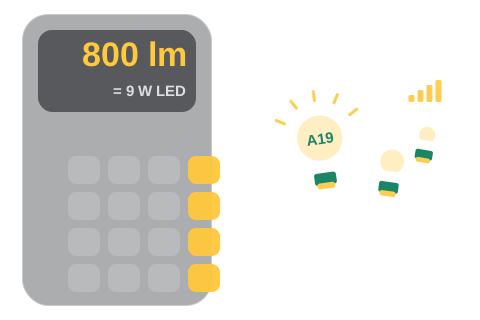
LED bulb calculator
Pick the incandescent bulb you are replacing. Your electricity rate and hours are starting figures: use your own.
Prices are Amazon listing prices as of 2026-11-04; check the price on Amazon before you buy.
Lumens to watts chart
| Incandescent | Brightness | LED equivalent |
|---|---|---|
| 40 W | 450 lm | 5-6 W |
| 60 W | 800 lm | 8-10 W |
| 75 W | 1,100 lm | 11-14 W |
| 100 W | 1,600 lm | 16-20 W |
| 150 W | 2,600 lm | 26-33 W |
LED equivalent assumes roughly 80 to 100 lumens per watt; efficient bulbs reach 100 or more: check the listing's stated watts.
Common questions
1How many lumens in a 60 watt bulb?
About 800 lumens. The usual equivalents are 450 lumens for 40 W, 800 for 60 W, 1,100 for 75 W, 1,600 for 100 W and 2,600 for 150 W. An LED giving 800 lumens uses roughly 8 to 10 watts.
2How do I convert lumens to watts?
Lumens measure brightness and watts measure power, so there is no single conversion: it depends on the light's efficiency. An old incandescent gave about 13 lumens per watt, a typical LED gives about 80 to 100 and efficient ones more. So 800 lumens is 60 W incandescent, or about 8 to 10 W LED. The calculator shows the stated watts of each listing.
3How many lumens do I need for a room?
A common rule is lumens per square foot of floor: about 10 to 20 for bedrooms and living rooms, 5 to 10 for hallways, 30 to 40 for kitchens and offices, and more (up to 70 to 80) at task areas such as vanities and counters. Guides vary, so treat these as starting points. Enter the room size above to get the total and the number of 800 lumen bulbs.
4How much does an LED bulb save?
Savings are the watts saved times hours of use times your electricity price. Replacing a 60 W bulb with a 9 W LED used 3 hours a day saves about 56 kWh a year, which is about $9 at 17 cents per kWh. Change the numbers above to match your home.
5What does the electricity rate mean?
It is what you pay per kilowatt-hour, shown on your bill. The starting value is a rough average: use your own rate for a better figure.
6What does 5000K, 2700K or 'daylight' mean?
Colour temperature: 2700K is warm white, 4000K neutral and 5000K to 6500K daylight. It does not change how many lumens a bulb gives.